
Reading Moab weather before choosing a trail
Moab weather makes spring and autumn useful starting points for outdoor plans, while summer heat and winter ice call for different choices. The National Park Service describes spring and autumn as more comfortable and also busier. Use the month as a planning filter, then choose the day's walk, drive or evening outing from the actual forecast and park conditions.
Moab is a base for Arches, Canyonlands, Dead Horse Point and the Colorado River. Those destinations should not all be treated as the same weather location. The climate table describes the town station, rather than every elevated plateau, canyon or trail. A pleasant temperature in town is only part of the information needed for an exposed walk.
Start with the season comparison if dates are flexible. For a particular outing, the hiking guide explains desert walking considerations, while Canyonlands access helps separate the park districts and their roads.
Monthly temperatures and rainfall
These NOAA NCEI climate normals use station MOAB, UT US, USC00425733, for 1991 to 2020. The station sheet was generated on 6 November 2026. Maximum and minimum columns are averages of daily temperatures, not records or a forecast. Rainfall is the monthly precipitation mean. Values describe a long period and cannot tell you whether a specific afternoon will be dry.
| Month | Mean daily maximum °C | Mean daily minimum °C | Precipitation mm |
|---|---|---|---|
| January | 6.4 | −5.9 | 16.5 |
| February | 11.2 | −2.7 | 16.8 |
| March | 18.1 | 2.0 | 17.8 |
| April | 22.4 | 5.9 | 19.6 |
| May | 28.1 | 10.4 | 20.8 |
| June | 34.4 | 14.9 | 8.9 |
| July | 37.3 | 19.1 | 23.4 |
| August | 35.5 | 17.8 | 22.4 |
| September | 30.9 | 12.6 | 22.6 |
| October | 23.1 | 5.4 | 26.2 |
| November | 13.9 | −0.9 | 17.8 |
| December | 6.6 | −5.6 | 19.3 |
Read the daytime and overnight columns together. A plan involving an early departure or an evening outside needs more than the afternoon figure. Monthly precipitation also cannot tell you when a storm will occur or whether a road will be passable. Keep the current forecast and the access report beside your itinerary rather than replacing them with this table.
Night-sky observing
For an evening outdoors, the astronomy experience provides telescopes and blankets.
Hand-picked tours, booked through GetYourGuide. Prices are indicative starting prices in US dollars (as of October 2026). Tap a tour for live availability and the current price in your currency.
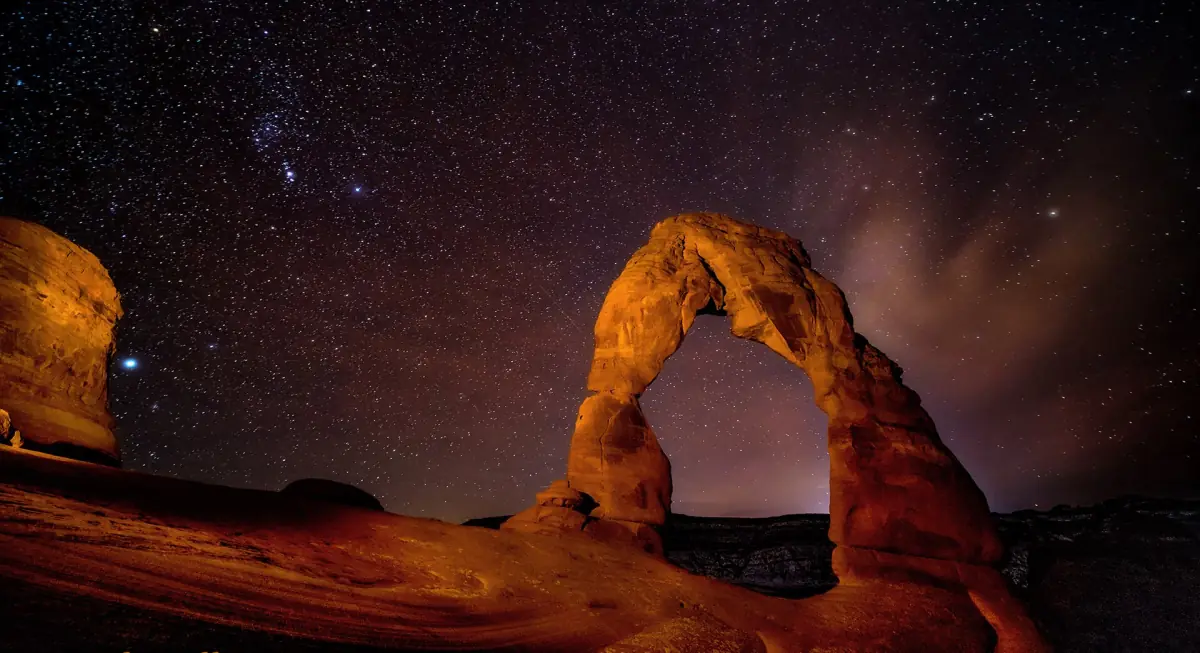
An evening with an astronomer
Use telescopes and astronomical binoculars on a stargazing outing with an astronomer; travel to the meeting point independently.
Summer heat, storms and water
Put strenuous activity into cooler parts of the day. The NPS safety guidance dated 4 August 2026 recommends at least 2 to 3 litres per person for frontcountry hikes and 4 litres or more in the backcountry, plus a reserve in the car. These are planning guidelines for different settings, not a fixed allowance that suits every person, route and temperature.
Flash flooding can happen even beneath locally blue skies. Do not cross flooded washes or roads. Rising or discoloured water, debris and the sound of a flood are reasons to seek higher ground. At thunder, seek shelter in a vehicle or building. For a technical canyon, weather belongs in the route decision before entry; a sunny photograph is no substitute for that decision.
Carry offline mapping and a paper map, and tell someone your route. In winter, snow clearing can temporarily close roads and ice can make trails dangerous. An open paved road does not establish that nearby dirt roads are passable. Leave room to change the day rather than making a distant viewpoint the only acceptable outcome.
Stargazing in Moab
The astronomy outing includes an astronomer, telescopes, astronomical binoculars, loungers, blankets and a hot beverage station. Transport is excluded, so arrange the journey to the Browns Hole Road meeting area and use the detailed meeting instructions for your departure. This is an evening centred on the sky, rather than a general nightlife excursion.
Clear skies and particular celestial views cannot be promised. Treat the weather forecast as part of planning the evening and allow the observing experience to depend on conditions. For a separate visit to Dead Horse Point, ordinary day access runs from 06:00 to 22:00. The day fee does not provide access after 22:00; overnight stays and authorised events have their own arrangements.
Weather planning questions
Are the monthly figures a forecast?
They are long-term normals for the Moab town station. Use them to compare months, then use the forecast and park notices to choose the actual route and departure time.
Can I plan a winter hike?
Make the choice around snow, ice and the current road and trail conditions. Keep an alternative that does not depend on reaching the same exposed viewpoint.
Does the astronomy outing include a transfer?
Travel to the meeting area independently. The outing supplies observing equipment, an astronomer, blankets, loungers and hot beverages; transport is excluded.